
The Operators revolution
One of the biggest drivers of a healthy startup ecosystem that is too rarely talked about

When I moved from San Francisco to Milan to invest in startups with an Italian DNA at IFF, I made the bet that Italy sits at a pivotal point, and that together we could influence its future trajectory by shaping some of the ingredients that make a successful startup ecosystem.
Said ingredients are many: founders, capital, and public institutions that facilitate entrepreneurship are often mentioned as areas that Italy has to catch up on.
But there is one ingredient in a successful entrepreneurial ecosystem that is too rarely mentioned, while sitting at its core and deciding outcomes more than we give it credit for: operators.
Operators is just a trendy, cool name for employees, but let’s use it because we love cool names.
Many of the greatest founders of our generation started as operators. To name a couple: Anton Osika, founder and CEO of Lovable, started his career as a founding engineer at Sana Labs, which recently was acquired for $1.1B. Alan Chang, founder and CEO of Fuse, spent 7 years at Revolut, going from analyst to CRO, before founding his own company.
There are many examples we could mention, but the bottom line is this: many great founders learned their craft as operators by absorbing the lessons of other entrepreneurs, and then went on to found companies and make their own vision true. It isn’t then too far of a stretch to say that without first becoming operators, many founders would not exist today.
But there’s more: without operators, startups successes would not be possible. It is preached many times that the density of talent is what decides the future of a startup. It’s one of the mantras behind the biggest Italian success: Bending Spoons. Without excellent operators, startups wouldn’t be able to reach the success they strive for.
You understand now why we believe in the importance of operators as a key driver in a healthy startup ecosystem: as a factory of future founders, and as the engine behind the success of startups.
But today in Italy, being a startup operator still lacks the allure of other prestigious careers, while possibly being the greatest path to founding a company. I believe that we need to push more young students and professionals outside of traditional “risk-free” careers and into startups.
There are many advantages of working at a startup:
You will learn faster: If we frame learning as a function of (i) the responsibility you are given, (aka the importance of the decisions you have to make), and (ii) the frequency at which you make those decisions (aka the shortness of the feedback loop), then working at a startup will drastically increase your rate of learning compared to a larger company. This is true because at startups you are generally given more responsibility early, and the rhythm at which make decisions is faster.
You will have more impact: Being one person out of 10, 50 or 100 is infinitely different than being one out of 2000. You are not a cog in the machine, and if you are missing, an important part of the business is missing. This puts pressure on you but also makes you way more important relative to your experience.
You will (likely) have more fun: Startups have less useless corporate rules, and working towards a mission with 20 more people is way more fun than marginally improving the conversion rate of a button for a big tech company ;)
All of the above is the whole reason why five degrees exists, and last Tuesday we partnered with them to gather the best founders in Italy and connect them to the highest-potential talents in the country.
five degrees is building the European layer of startup talent, and they chose IFF as their partner for the Italian stop of the Europe Tour they have embarked on at the start of 2026. What I said above about founders learning their craft at top startups before starting their own, is the founding belief behind five degrees. They call it The Entrepreneurial Talent Flywheel:
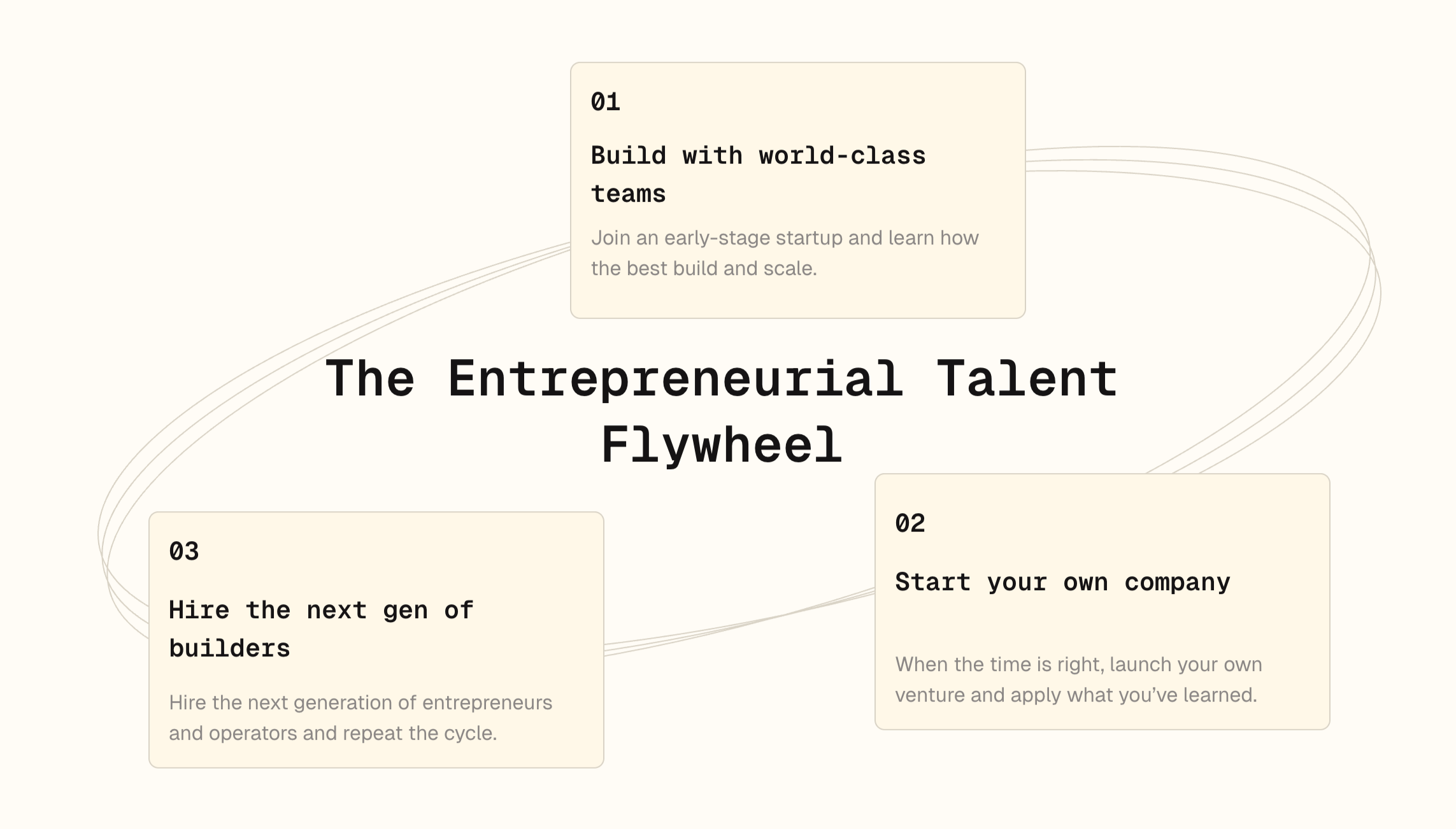
As proof of this, out of the founders pitching last Tuesday, the majority were ex-operators that then decided to build their company. I suspect that many of the talents that joined the event will go and build their own companies 👀
At IFF, our goal is to shape an ecosystem that is second to none in Europe. These events are what makes our mission possible. This is where talent can truly shine (and we’re here for it).
We want to thank five degrees for organizing one of the highest-signal showcases we ever saw in Milan. I kept thinking about that energy for days. There will be more to come.
Irene
 | A guest post by
|